Stallion Promotion
Tips for Taking the Perfect Conformation Photo
This is part three in our photo series, the previous two articles in this series: “The Importance of Good Photographs” and “Getting Ready to Take Good Photos” can be accessed from our "Articles" page. They explain why great photos are essential to marketing your stallion and what you will need to do to set up for your photo session. This article gives you some tips on how to take good photos, but of course, the best and easiest way is to get a professional photographer.
It will be helpful to have a magazine with lots of horse photos in it, a stallion edition is perfect, to look through and compare how pictures look while reading the information in this article.
Preparation - a brief review as it is covered in depth in article 2. Your horse needs to be clean and appropriately dressed and your helpers (one or two) ready. Your level area and background with few visual distractions has been chosen and cleaned up if necessary. You have at least two rolls of film or two disposable cameras and a nice day. Now you are ready to start your photo session.
Conformation pictures should be appropriate to your breed or the breed of mares you are trying to attract to your stallion. The easiest way to find this out is to then study the stallions of your breed in the stallion edition of a glossy magazine.
The stallion handler should stand far enough away that she does not show in the photo or so that it will be easy to cut her out of the photo without leaving her hand under his chin.
When taking a side conformation shot you want to see all four legs. You want the cannon bones of the legs nearest you to be vertical. The legs on the far side should be closer together than the legs nearest to you, so that you can see them clearly under his belly. Stand your stallion so the sun is shining from behind you and slightly from the rear of the side of the horse that you will be photographing. This way when his head is turned towards you, his neck is not shadowed and his muscles and contours are nicely defined.
His head should be turned towards you just enough to show off his forehead, opposite nostril and eye brow, but not so much you see the opposite eye, this gives a nice view of his head. You want his ears pointed forward, to do this your third helper may be required to attract his attention by waving a plastic bag on a stick or shaking a pan of grain from which he gets an occasional bite. You don’t want to scare your stallion, if using a plastic bag or other “scary” item start quietly and then increase the movements until you have his attention.
You want to be lined up with the centre of his barrel and far enough from him that you get all of him in. This gives a good, distortion free photo of your stallion. If you wish to emphasize his great hindquarters, then move a little ways towards the back of your horse to take the photo, not too much or his front end (head, chest, etc.) will look small.
The camera should be positioned level with the center of the stallions’ barrel so the photo will be taken looking straight on or slightly up at the horse, you may have to kneel or crouch down. Looking up at the horse makes him appear larger in the picture. Never shoot a conformation photo looking down on a horse because it distorts his looks by shortening his legs and broadening his back, not a flattering look at all. Also make sure that you hold the camera level horizontally so that the background fence or horizon is level.
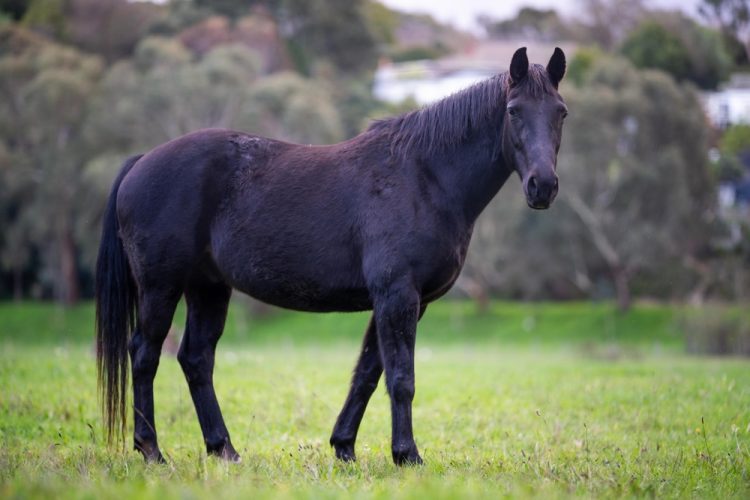
Even though you are taking the picture during the day, using the flash will lessen shadows, bring out more details on your horse and add highlights to his eye. It also adds more light so your stallion stands out better against the background. Using a flash is especially important when you have a black horse. Black horses are really hard to get good photos of and an overcast day will work best.
Technical Notes: Use ISO 400 film because it will be able to use more of the light generated by the flash to bring out the detail.
Lock the focus if you have an auto-focus camera. Auto-focusing cameras don’t always focus on what you think is the important part of your picture and not even the best photo finisher can correct an improperly focused horse.
While a camera with a telephoto or lens over 70mm works the best, decent photos can be taken with the disposable cameras.
Finally, keep trying, even the professionals will take many photos to get the right one. While it is frustrating when your stallion moves after you have just got everything lined up, or the wind is blowing his mane and tail around, getting your photos back and finding you’ve taken the perfect photo is the best reward.
Check out:The Importance of Good Photos and Getting Ready to Take Great Photos
![]()
Updated September 22, 2002
Send mail to
webmaster@stallionsofcanada.com
with questions or comments about this web site.
Copyright © 2002 Canada Breeder's Directory